
wspollack
Well-known member
Note: this morning, I did a write-up in response to some questions I was asked in a PM. Thinking about it later, I decided that other folks here -- especially those riders who are new to the world of scooters and the bodywork that's slathered on them -- might find this kind of discussion useful. Hence, the following is largely a cut-and-paste of that earlier response.
1) Yep, that is the manual, that's the vendor I bought the C 400 GT shop manual from in 2022 (see https://www.bmw-scooters.com/threads/bought-pdf-shop-manual-for-c-400-gt-on-ebay.2474/):

2) Regarding its applicability to assorted model years:
- With the 2025 model BMW changed the top case, its support rack, maybe the underseat area, and made the windscreen manually adjustable.
- The only difference between my former 2022 and my current 2023, for instance -- both in the same Callisto Gray Metallic -- is that the front brake calipers are colored gold instead of silver.
- I'm not aware of any changes from 2022 - 2024, except maybe colors, so my strong guess is that the manual will be relevant to the 2024 model, too, i.e., in addition to my former '22 and my current '23.
3) Note that the owner's manual that everyone should already have has some help to get folks started, regarding body-panel removal.
If you haven't noticed this already, in the MAINTENANCE section, and within that section the TRIM PANEL COMPONENTS sub-section, there are a few bodywork-removal pages. This starts around page 166, and talks about the battery cover and fairing side panel.
4) The shop manual does have pretty good info -- similar to the those limited descriptions in the owner's manual -- on removing all the panels*.
Unfortunately, that info is all over the place.
That is, the gold standard for such work, in my experience, was my 2007 paper shop manual for my '07 Burgman 650 (and nine years later, when I bought a used '08 Burgman 650).
That manual had an entire chapter on nothing but bodywork removal, with a page or two dedicated to each panel. On top of that, it started off with a flow chart, showing the order of panel removals, i.e., you have to take off this panel before you can even think of removing that panel.
The C 400 GT shop manual, on the other hand, sucks, in terms of finding where exactly each panel's removal is discussed. The problem is two-fold:
- A given panel may be mentioned all over the place, but ONLY because it must be removed to gain access to something else, some part that the manual is really talking about. For instance, if you want to replace such-and-such a sensor, then you must remove this and that panel.
- While removing a given panel may be mentioned all over the place, the specific details of its removal will be discussed only in one place, typically when it is the first step of gaining access to some sensor, some non-panel part, etc.
Because of that approach -- the random nature of the shop manual, with respect to body panels -- I have annotated my copy of that shop manual, so I can find what I'm looking for, the next time I'm playing with the bodywork.
This is a cut-and-paste of what I currently have on a formerly blank page two of the file. If you don't want to mess with the PDF file itself, you can always just put this into a TXT file or something. The pages I specify may be one or two pages off, but you get the point. The phrases I list should match the actual words I wound up using for each search:
Removing number plate carrier with rear light: 693
Installing rear-light unit: 695
Removing right rear trim panel: 716
Removing left rear trim panel: 719
Replacing left top side panel: 723
Replacing front left side panel: 724
Replacing side panel (mid-bike, Powerlet), left: 721
Removing headlight cover at the top: 801
Renewing upper section of fairing (headlight surround): 713
Removing rear-light unit: 803
Removing top handlebar cover: 818
Removing bottom handlebar cover: 819
Releasing the bearing support for the gas pressure spring: 827
Removing luggage-compartment bottom section: 827
Removing left grab handle: 828
Removing right grab handle: 828
Installing luggage carrier: 828 (Loctite 243, Medium strength)
That info above represents hours of my searching through that PDF file.
* (To my knowledge, and for some unknown reason, the only piece of bodywork that's missing from the shop manual, in terms of its removal, is the small sort of triangular piece behind the windscreen, looking from the front of the bike back toward the rear. It has three barbs, and just pulls out, frontwards, from the bike.)
5) Having removed bodywork parts umpteen times -- I had those two Burgman 650s for a total of 11 years, and bodywork had to be removed for each oil change, for instance -- I have some pointers about this (and don't forget to read those few pages in the owner's manual).
First, buy some nylon bodywork tools.
Here are the ones I have:
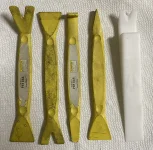
On the left is a "Nylon Pry Bar Installer Kit, 4 Piece" set from Harbor Freight that I've been using for 20 years or so:

 www.harborfreight.com
On the right is a single, higher-quality, "Plastic Combination Wedge" that I threw in -- on a whim, as I recall -- when ordering some other stuff from Wunderlich:
The most important thing to remember when working with panels with spring clips is that you work your way around a given panel, multiple times, a little bit at a time with each pass.
That is, you don't try to get one corner completely out, and then move on to another corner.
Instead, use a pry bar to just get a corner started to be removed, maybe a quarter inch or so. Then slide along your tiny gap, and get the removal of the next clip just started, too. And then work your way all around, etc.
When you've finished that first pass, pry that first clip a little more open, e.g., another quarter or half inch or so. And work your way around again, and so on ... until clips start to become fully released.
Of course, you need to remove any screws first. Most of the bodywork pieces are held in place by a couple of screws AND by the metal spring clips. You can see these kind of details in those few pages in the owner's manual and on the pages I've listed in the shop manual.
There are larger Torx-head bolts on the structural and mechanical parts of the C 400, but I believe that all of the screws on the bodywork are T25, and almost all of them are the same length, and very few of them are "shouldered"; see https://billanddot.com/C400GT/#S-19 .
(For some suggestions on Torx tools, see my post from last fall: https://www.bmw-scooters.com/threads/my-torx-tools-additions-since-acquiring-a-c-400-gt.3338/.)
One more thing: to make life a tiny bit easier for next time, I recommend plumber's grease, e.g.:
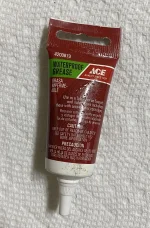
(That particular tube is https://www.acehardware.com/departments/plumbing/plumbing-tools/plumbing-grease/4200879.)
What I do is use my finger to coat the outside of each metal spring clip with this stuff. The grease lasts a long time, and it reduces the friction of the clips against the "receiving" plastic when you put a panel piece back on or take it off again.
Oh, yeah, putting panels back on -- the ones with all those metal spring clips -- is sort of the reverse of removal. Get the clips lined up with their respective openings, and push them more and more in place: similar to removal, don't feel that you have to press a clip back in fully all at once; instead, you can once again sort of work your way around each piece, pushing it partially back in with each pass. For the absolute final pass, I use my palm or the side of a fist on a given section of a bodywork piece, to make sure that each corresponding clip is fully sprung into place.
A few of the bodywork panels also have edges that have to be aligned a little, to go into slotted area or ridges, whether they have spring clips or not. I think the battery cover is one such piece. That is, pay attention to how a given piece is positioned, in relation to the edges of other pieces that it may touch, when starting to remove it.
The Beemer is MUCH better in this respect than the Burgman. Many of the Suzuki panels had very small, very thin, tabs that slid into very small slits in other pieces, and these tabs would inevitably break off over time.
Also, the Burgman had gobs of plastic spread-apart screw/rivet connectors, and these, too, would break fairly often (to the point where many of us bought assortments of these for spares). The C 400, in contrast, has much better panels, and uses only real metal screws and clips. (Well, the underseat tub on the C 400 GT has two of these plastic "pop rivets" up front, but they're the only two such plastic fasteners I'm aware of on the bike, compared to dozens -- hundreds? -- on the Burgman.)
Last, if anyone ever messes with the underseat tub, heed my warning (and experience): try very hard not to break the delicate switch in the rear of the tub, the one that tells the ECU whether the flexcase is up or down. Too see a picture of a broken one, click here: https://billanddot.com/C400GT/#S-35.
That's all I got.
1) Yep, that is the manual, that's the vendor I bought the C 400 GT shop manual from in 2022 (see https://www.bmw-scooters.com/threads/bought-pdf-shop-manual-for-c-400-gt-on-ebay.2474/):
BMW C 400 GT K08 WORKSHOP C400GT SERVICE MANUAL ON USB | eBay
BMW C 400 GT K08 SERVICE MANUAL ON USB. MODEL: K08. BMW CODE: 0C06, 0C16. Another BMW modelshere. FORMAT: USB STICK. Digital service manual in English that contains all the necessary instructions needed for any repair your vehicle may require.
www.ebay.com
2) Regarding its applicability to assorted model years:
- With the 2025 model BMW changed the top case, its support rack, maybe the underseat area, and made the windscreen manually adjustable.
- The only difference between my former 2022 and my current 2023, for instance -- both in the same Callisto Gray Metallic -- is that the front brake calipers are colored gold instead of silver.
- I'm not aware of any changes from 2022 - 2024, except maybe colors, so my strong guess is that the manual will be relevant to the 2024 model, too, i.e., in addition to my former '22 and my current '23.
3) Note that the owner's manual that everyone should already have has some help to get folks started, regarding body-panel removal.
If you haven't noticed this already, in the MAINTENANCE section, and within that section the TRIM PANEL COMPONENTS sub-section, there are a few bodywork-removal pages. This starts around page 166, and talks about the battery cover and fairing side panel.
4) The shop manual does have pretty good info -- similar to the those limited descriptions in the owner's manual -- on removing all the panels*.
Unfortunately, that info is all over the place.
That is, the gold standard for such work, in my experience, was my 2007 paper shop manual for my '07 Burgman 650 (and nine years later, when I bought a used '08 Burgman 650).
That manual had an entire chapter on nothing but bodywork removal, with a page or two dedicated to each panel. On top of that, it started off with a flow chart, showing the order of panel removals, i.e., you have to take off this panel before you can even think of removing that panel.
The C 400 GT shop manual, on the other hand, sucks, in terms of finding where exactly each panel's removal is discussed. The problem is two-fold:
- A given panel may be mentioned all over the place, but ONLY because it must be removed to gain access to something else, some part that the manual is really talking about. For instance, if you want to replace such-and-such a sensor, then you must remove this and that panel.
- While removing a given panel may be mentioned all over the place, the specific details of its removal will be discussed only in one place, typically when it is the first step of gaining access to some sensor, some non-panel part, etc.
Because of that approach -- the random nature of the shop manual, with respect to body panels -- I have annotated my copy of that shop manual, so I can find what I'm looking for, the next time I'm playing with the bodywork.
This is a cut-and-paste of what I currently have on a formerly blank page two of the file. If you don't want to mess with the PDF file itself, you can always just put this into a TXT file or something. The pages I specify may be one or two pages off, but you get the point. The phrases I list should match the actual words I wound up using for each search:
Removing number plate carrier with rear light: 693
Installing rear-light unit: 695
Removing right rear trim panel: 716
Removing left rear trim panel: 719
Replacing left top side panel: 723
Replacing front left side panel: 724
Replacing side panel (mid-bike, Powerlet), left: 721
Removing headlight cover at the top: 801
Renewing upper section of fairing (headlight surround): 713
Removing rear-light unit: 803
Removing top handlebar cover: 818
Removing bottom handlebar cover: 819
Releasing the bearing support for the gas pressure spring: 827
Removing luggage-compartment bottom section: 827
Removing left grab handle: 828
Removing right grab handle: 828
Installing luggage carrier: 828 (Loctite 243, Medium strength)
That info above represents hours of my searching through that PDF file.
* (To my knowledge, and for some unknown reason, the only piece of bodywork that's missing from the shop manual, in terms of its removal, is the small sort of triangular piece behind the windscreen, looking from the front of the bike back toward the rear. It has three barbs, and just pulls out, frontwards, from the bike.)
5) Having removed bodywork parts umpteen times -- I had those two Burgman 650s for a total of 11 years, and bodywork had to be removed for each oil change, for instance -- I have some pointers about this (and don't forget to read those few pages in the owner's manual).
First, buy some nylon bodywork tools.
Here are the ones I have:
On the left is a "Nylon Pry Bar Installer Kit, 4 Piece" set from Harbor Freight that I've been using for 20 years or so:
Nylon Pry Bar Installer Kit, 4 Piece
Amazing deals on this at Harbor Freight. Quality tools & low prices.
On the right is a single, higher-quality, "Plastic Combination Wedge" that I threw in -- on a whim, as I recall -- when ordering some other stuff from Wunderlich:
The most important thing to remember when working with panels with spring clips is that you work your way around a given panel, multiple times, a little bit at a time with each pass.
That is, you don't try to get one corner completely out, and then move on to another corner.
Instead, use a pry bar to just get a corner started to be removed, maybe a quarter inch or so. Then slide along your tiny gap, and get the removal of the next clip just started, too. And then work your way all around, etc.
When you've finished that first pass, pry that first clip a little more open, e.g., another quarter or half inch or so. And work your way around again, and so on ... until clips start to become fully released.
Of course, you need to remove any screws first. Most of the bodywork pieces are held in place by a couple of screws AND by the metal spring clips. You can see these kind of details in those few pages in the owner's manual and on the pages I've listed in the shop manual.
There are larger Torx-head bolts on the structural and mechanical parts of the C 400, but I believe that all of the screws on the bodywork are T25, and almost all of them are the same length, and very few of them are "shouldered"; see https://billanddot.com/C400GT/#S-19 .
(For some suggestions on Torx tools, see my post from last fall: https://www.bmw-scooters.com/threads/my-torx-tools-additions-since-acquiring-a-c-400-gt.3338/.)
One more thing: to make life a tiny bit easier for next time, I recommend plumber's grease, e.g.:
(That particular tube is https://www.acehardware.com/departments/plumbing/plumbing-tools/plumbing-grease/4200879.)
What I do is use my finger to coat the outside of each metal spring clip with this stuff. The grease lasts a long time, and it reduces the friction of the clips against the "receiving" plastic when you put a panel piece back on or take it off again.
Oh, yeah, putting panels back on -- the ones with all those metal spring clips -- is sort of the reverse of removal. Get the clips lined up with their respective openings, and push them more and more in place: similar to removal, don't feel that you have to press a clip back in fully all at once; instead, you can once again sort of work your way around each piece, pushing it partially back in with each pass. For the absolute final pass, I use my palm or the side of a fist on a given section of a bodywork piece, to make sure that each corresponding clip is fully sprung into place.
A few of the bodywork panels also have edges that have to be aligned a little, to go into slotted area or ridges, whether they have spring clips or not. I think the battery cover is one such piece. That is, pay attention to how a given piece is positioned, in relation to the edges of other pieces that it may touch, when starting to remove it.
The Beemer is MUCH better in this respect than the Burgman. Many of the Suzuki panels had very small, very thin, tabs that slid into very small slits in other pieces, and these tabs would inevitably break off over time.
Also, the Burgman had gobs of plastic spread-apart screw/rivet connectors, and these, too, would break fairly often (to the point where many of us bought assortments of these for spares). The C 400, in contrast, has much better panels, and uses only real metal screws and clips. (Well, the underseat tub on the C 400 GT has two of these plastic "pop rivets" up front, but they're the only two such plastic fasteners I'm aware of on the bike, compared to dozens -- hundreds? -- on the Burgman.)
Last, if anyone ever messes with the underseat tub, heed my warning (and experience): try very hard not to break the delicate switch in the rear of the tub, the one that tells the ECU whether the flexcase is up or down. Too see a picture of a broken one, click here: https://billanddot.com/C400GT/#S-35.
That's all I got.