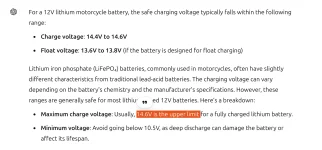
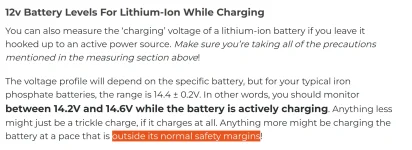
I'm sorry, this data is for a sales pitch, but technically incorrect.
The native voltage of lithium-iron-phosphate battery cells (LifePO4) is 3.3 Volts (compared with 3.7 for conventional lithium-ion).
To make a standard 12-volt motorcycle battery, 4 cells are used, giving a battery with a native voltage of 13.2 volts (3.3*4). The 12.8 Volts advertised in your screenshot is a so-called operating voltage. But in reality, the battery (or rather each battery cell) must be recharged to its maximum native capacity, i.e. 3.3 Volts per cell. As a result, the resting voltage of your new or been recharged LiFePO4 battery will be 13.2 Volts and not 12.8 Volts (you can have fun measuring a new, fully-charged battery if you don't believe me).
I say this because it's important to understand the charging and discharging limits of these batteries.
The figure of 10.5 Volts (although wrong here*) corresponds to a deep discharge level, which damages the battery's capacity and lifespan. For my part, I'm talking about a low battery level, not a deep discharge.
Having said that, it's important to understand the difference, because deep discharge indicates a battery that has been discharged beyond what it can withstand before its capacity degrades.
But a low battery level (which is what I'm talking about) has nothing to do with discharge, and even less to do with deep discharge! It corresponds to the voltage measured on a battery at rest, but well and truly charged!
So here's what you need to understand: When a LiFePO4 battery is fully charged but its resting voltage is below 13 Volts, it's considered to be weak (or worn out, if you prefer).
Finally, the overcharge voltage of a lithium battery corresponds to the maximum permissible voltage in each cell. This maximum voltage is very simply determined by the reactions taking place in the components (chemical oxidation). It occurs when the overcharge of each cell exceeds the native voltage of +1.5 volts (lithium-ion-polymer) or +1.3 volts (lithium-iron-phosphate).
In our case, this means that the overcharge voltage is (3.3+1.3)*4 or 18 Volts. Below this voltage, the battery's chemical cycling will remain stable. On high-quality, seriously manufactured batteries, the integrated control circuit (BMS) is able to stop charging as soon as the cells are individually full, and will never allow a charging voltage of more than 15.5 volts, or put the battery into a safety mode. So when a lithium battery explodes, it's not because it's been charged to 14.8 volts, but because its BMS has failed to stop charging.
* This figure is incorrect, as it corresponds more closely to lithium-ion-polymer batteries, which have native voltages of 3.7 Volts per cell and a discharge limit of 2.5 Volts per cell (i.e. 10 Volts for 4 cells). In the case of LiFePO4 batteries with 3.3 Volts per cell, the deep-discharge voltage is actually 9.4 Volts (2.35 Volts per cell).