• Welcome to the BMW Scooter Forums. Member registration disables ads and allows you to post and share. Register Here.

Need new battery C650 Sport. Options?

One issue with antigravity batteries being discussed on the BMW K1600 forum currently, is that apparently they are sensitive to heat and can literally 'shut down' if they get too hot, which has been happening to some K1600 owners. On K1600s they are located under the seat, away from the engine as is the case on the C650.
 
Technically, the high voltage of the 14.8V charging circuit is an advantage for lithium batteries. In fact, these batteries “prefer” high charging voltages (15V instead of 13, as is the case with dedicated chargers). In theory, this increases their lifespan. In fact, a lithium battery is considered “weak” when its quiescent voltage drops below 13V, whereas conventional technology requires a voltage below 12.3V.

Weight savings are also interesting, if they are not sought in isolation with a lighter battery, but as part of an overall approach: for example, with a lighter exhaust system, by removing the center stand, etc...

Technical considerations aside, my experience with lithium batteries on my motorcycles has been disappointing. These batteries react badly in winter (for a good start, for example, you have to warm them up by switching on the lights for a minute before starting the engine). But their capacity is comparatively low (4Ah vs. 14Ah), so you can't play with this aspect indefinitely (even if this low capacity means they'll be fully recharged in a few minutes once the engine has started).
Lithium batteries also have very short lifetimes! They weaken very quickly (in a matter of weeks or months) if you don't maintain them to the highest standards. For example, if you don't connect a maintenance charger regularly, even if you drive every day.
Finally, lithium batteries are not designed for a vehicle like the C600/650. They are suitable for a competition bike with very few electrical components. But on a motorcycle with a lot of active and comfort equipment (ABS, ASC, TPMS, automatic and daytime running lights, heating elements, etc.) the lithium battery won't provide sufficient support for the generator. It will even be very poor in full-charge situations (the minutes following start-up or freeway use with many electrical consumers switched on).
Other components, such as the generator or regulator, could then age prematurely due to this low battery capacity.
 
I bought the OEM battery that came with the BEEMER it lasted 7.5 years it did cost
abit but still worth it. I never had any batteries last that long on scooters. I will see
how long this battery lasts,
 
Technically, the high voltage of the 14.8V charging circuit is an advantage for lithium batteries. In fact, these batteries “prefer” high charging voltages (15V instead of 13, as is the case with dedicated chargers). In theory, this increases their lifespan. In fact, a lithium battery is considered “weak” when its quiescent voltage drops below 13V, whereas conventional technology requires a voltage below 12.3V.
1731807322635.webp
1731807489396.webp
 
I had an incorrectly installed alarm on my 2013. If I didn’t ride it every 2-3 days it would drain the battery so low it would not crank. I tried using a battery charger but it would not restore power. They were Napa batteries and they must have swapped at least 6 in a two year period before getting a full sized Battery Tender (the Junior did not put out enough to keep it charged). Shop finally diagnosed improper installation on alarm and fixed the problem. Maybe it was just my local Napa store but I would walk in with the battery and my receipt and after checking the battery they would hand me a new battery and revised receipt.
 
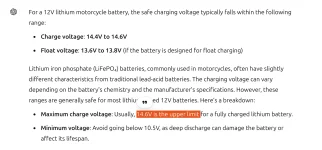
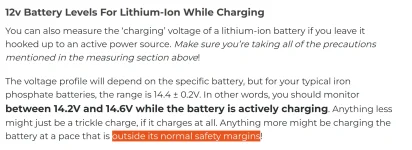
I'm sorry, this data is for a sales pitch, but technically incorrect.

The native voltage of lithium-iron-phosphate battery cells (LifePO4) is 3.3 Volts (compared with 3.7 for conventional lithium-ion).

To make a standard 12-volt motorcycle battery, 4 cells are used, giving a battery with a native voltage of 13.2 volts (3.3*4). The 12.8 Volts advertised in your screenshot is a so-called operating voltage. But in reality, the battery (or rather each battery cell) must be recharged to its maximum native capacity, i.e. 3.3 Volts per cell. As a result, the resting voltage of your new or been recharged LiFePO4 battery will be 13.2 Volts and not 12.8 Volts (you can have fun measuring a new, fully-charged battery if you don't believe me).

I say this because it's important to understand the charging and discharging limits of these batteries.

The figure of 10.5 Volts (although wrong here*) corresponds to a deep discharge level, which damages the battery's capacity and lifespan. For my part, I'm talking about a low battery level, not a deep discharge.

Having said that, it's important to understand the difference, because deep discharge indicates a battery that has been discharged beyond what it can withstand before its capacity degrades.

But a low battery level (which is what I'm talking about) has nothing to do with discharge, and even less to do with deep discharge! It corresponds to the voltage measured on a battery at rest, but well and truly charged!

So here's what you need to understand: When a LiFePO4 battery is fully charged but its resting voltage is below 13 Volts, it's considered to be weak (or worn out, if you prefer).

Finally, the overcharge voltage of a lithium battery corresponds to the maximum permissible voltage in each cell. This maximum voltage is very simply determined by the reactions taking place in the components (chemical oxidation). It occurs when the overcharge of each cell exceeds the native voltage of +1.5 volts (lithium-ion-polymer) or +1.3 volts (lithium-iron-phosphate).

In our case, this means that the overcharge voltage is (3.3+1.3)*4 or 18 Volts. Below this voltage, the battery's chemical cycling will remain stable. On high-quality, seriously manufactured batteries, the integrated control circuit (BMS) is able to stop charging as soon as the cells are individually full, and will never allow a charging voltage of more than 15.5 volts, or put the battery into a safety mode. So when a lithium battery explodes, it's not because it's been charged to 14.8 volts, but because its BMS has failed to stop charging.

* This figure is incorrect, as it corresponds more closely to lithium-ion-polymer batteries, which have native voltages of 3.7 Volts per cell and a discharge limit of 2.5 Volts per cell (i.e. 10 Volts for 4 cells). In the case of LiFePO4 batteries with 3.3 Volts per cell, the deep-discharge voltage is actually 9.4 Volts (2.35 Volts per cell).

 
Back
Top